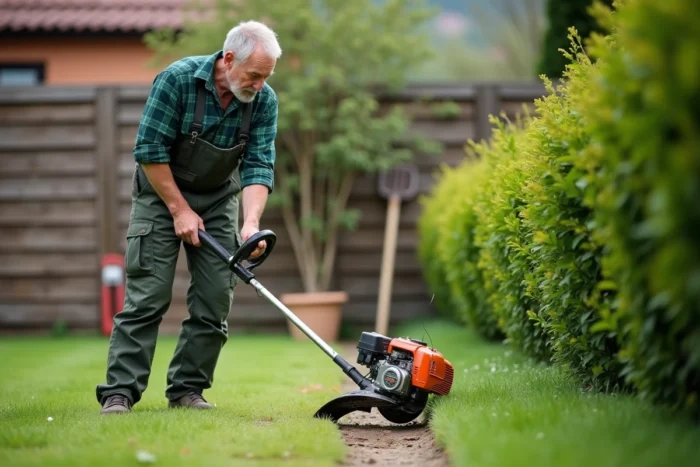
A motor that proudly displays its 30 cm³ will not always be up to the task against a thick edge or uneven ground. Some devices that rely solely on power end up becoming dead weights, exhausting their user after just a few minutes.
The market is overflowing with models, technologies, and options, to the point that one can easily get lost: engine displacement, transmission mode, cutting width, anti-vibration technologies… every detail can significantly impact both performance and user comfort. Knowing where to focus your attention avoids many disappointments and allows you to invest in a device that is truly suited to the configuration of your terrain.
Thermal brush cutter or string trimmer: how to choose for your edges?
Under the label of gardening tool, two machines compete in the art of taming the edge: the thermal brush cutter and the string trimmer, also known as a rotofil. Each has its preferred terrain, and their uses never completely overlap.
The thermal brush cutter comes into play as soon as the grass grows tall or when underbrush appears. It cuts wide, tackling brambles, undergrowth, and slopes without weakening. Its striking power allows it to tackle areas inaccessible to lighter tools. Thanks to its interchangeable head, it easily switches from nylon line for finishing touches to a blade or disc for thick underbrush.
On the other hand, the string trimmer provides the finishing touch: perfect edges, contours of flower beds, corners neglected by the mower. Its maneuverability, lightness, and precision make it an ally for small areas. For this type of work, the String Trimmer ticks all the boxes for a clean and quick cut, without unnecessary effort.
The choice thus depends on the nature of the vegetation and the terrain’s relief: favor the thermal brush cutter for heavy-duty tasks, and the string trimmer for impeccable finishes. Professionals repeat: it’s the use that dictates the equipment, never the other way around. This adaptation remains the secret to sustainable maintenance without unpleasant surprises.
Overview of models and features to choose the right tool for your needs
As soon as the area expands, or tall grasses multiply, the thermal brush cutter shows its true value. For large terrains and dense undergrowth, it naturally stands out due to its robustness and endurance. The thermal engine, usually two-stroke, delivers immediate power, ideal for long sessions. Four-stroke versions are appealing for their quieter operation but weigh a bit more on the shoulder. Each terrain profile has its ergonomics: backpack brush cutters relieve on slopes, while wheeled models move effortlessly across large plains.
For more modest gardens, the electric brush cutter or battery-operated model changes the game. It works silently, is lighter, and can maneuver anywhere. Battery versions, freed from the cord, gain in freedom of movement, which is very useful in remote corners or areas without nearby outlets.
The choice of cutting equipment directs the tool: nylon line for soft grass, blade or disc for underbrush or stubborn regrowth. Interchangeable heads, now common, allow the tool to be adapted to the task at hand. On all models, certain features make a difference: an ergonomic harness, a well-designed handle, a protective guard, and a sturdy drive shaft. These details translate into safety, comfort, and the longevity of the device.
Before making your choice, consider the size of your terrain, the frequency of use, and the type of plants to be cut. Each brush cutter has been designed to meet a specific configuration and guarantee results that meet expectations.

Essential tips for effective and safe use of your brush cutter
Equipping yourself to work without putting yourself in danger
Before starting, adopt the right reflexes regarding equipment. Sturdy gloves, protective glasses, and covering clothing form an effective barrier against flying debris and scratches. As soon as the terrain becomes complicated or the vegetation thickens, a helmet with a visor becomes essential. Finally, add safety shoes: they ensure good stability, especially on uneven or wet ground.
Handling the tool with precision, limiting fatigue
A well-fitted harness distributes the weight of the machine and spares the back during long sessions. Take the time to adjust it; your comfort depends on it. The ergonomic handle facilitates movements: always keep both hands on the device and adjust the speed according to the density of the grass or the terrain’s topography. Never forget: the protective guard must remain in place to deflect flying debris.
Keep these points in mind to ensure the performance and longevity of your equipment:
- Check the cutting head before each use: nylon line, blade, or disc must be in perfect condition. A worn tool fatigues the motor and compromises the work.
- Clean the machine after use, removing all residues, and check the air filter and accessory attachments.
- Record each intervention in a logbook: regular maintenance prolongs the life of the brush cutter and minimizes issues.
Safety cannot be delegated. Never touch the cutting head while the engine is running, keep children and pets at a distance, and always prefer an open space to work calmly.
Equipped with the right tool and precise movements, trimming the edges is no longer a daunting task but a mastered gesture. Over the seasons, the garden remembers.