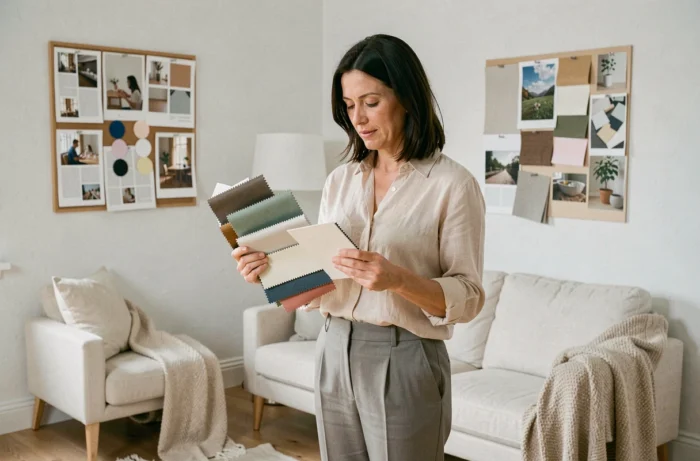
French households are redirecting their housing expenses. In the first half of 2026, the decoration trade declined by 0.9%, while external thermal insulation increased by 7.3%. This shift reflects a concrete trade-off: the energy performance of housing takes precedence over decorative aesthetics. Understanding trends and tips for your home requires taking this budgetary reality into account before discussing colors or furniture.
Reuse of furniture: a regulatory constraint that changes the game
The REP furniture sector (extended producer responsibility) has tightened its specifications for the period 2024-2029. Three eco-organisms have been approved since 2024: Ecomaison, Valdelia, and Valobat. Their objectives focus on the repair, reuse, and recycling of furniture, with more stringent thresholds than before.
For individuals, this translates into a growing offer of refurbished furniture in stores and online. Before buying a new table, sofa, or dresser, checking second-hand circuits is no longer a marginal approach. It is a reflex encouraged by the regulation itself.
On the practical side, several platforms and local resource centers now offer controlled furniture. To explore these topics in detail, the home sections on Info du Web gather files covering both furniture and renovation.
MaPrimeRénov’ in September 2026: what has changed for your work
The rules of MaPrimeRénov’ have tightened since September 2026. The “by gesture” pathway now focuses on replacing gas or oil heating systems. Insulation alone is no longer eligible for the by gesture pathway. This change modifies the way to plan a renovation: coupling insulation with a heating system change becomes the norm to access aid.
Major renovations target homes classified E, F, or G and require at least two insulation actions. A prior visit to France Rénov’ is mandatory: an advisor frames the project before the file submission, and the work must not start before the necessary validations. Starting a project too early risks losing access to funding.
Concrete traps to avoid when assembling the file
- Do not sign a quote with a contractor before receiving confirmation from France Rénov’, even if the company pressures you with a deadline.
- Check that the contractor holds an up-to-date RGE qualification for each type of work considered (insulation, heating, ventilation).
- Keep energy performance diagnostics before and after work: they condition the payment of bonuses on major renovations.
Indoor materials and chemical substances: an underestimated selection criterion
Regulatory developments push towards upholstery textiles and coatings with reduced chemical content. This is no longer just a niche concern: materials now integrate health considerations on par with aesthetics.
For the living room or bedroom, this concerns sofa foams, wall paints, and soft flooring. Labels (Oeko-Tex for textiles, A+ for VOC emissions on coatings) remain the most readable indicators for a non-specialist buyer.
Interior decoration: balancing trend and durability
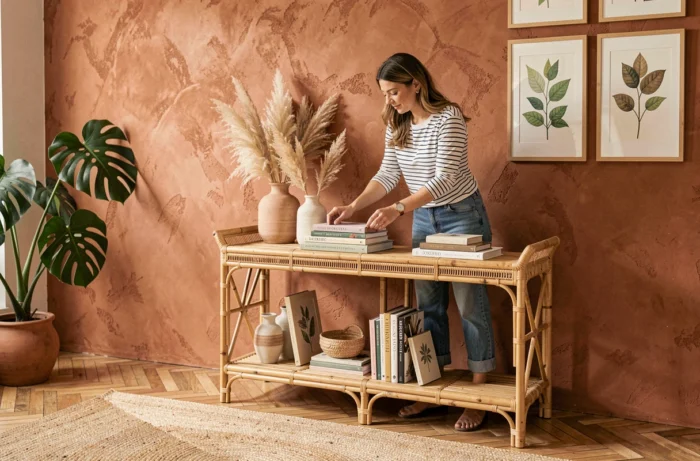
Current decor trends highlight natural materials (wood, linen, terracotta) and earthy colors. This orientation aligns with health and environmental requirements. A solid wood piece sourced from reuse ticks several boxes: durability, aesthetics, low chemical emissions.
On the other hand, very trendy items with rapid turnover (seasonal decorative accessories, ephemeral patterned textiles) pose a waste problem. Favoring enduring elements for major items (sofa, storage, lighting) and reserving renewal for small accessories limits budgetary and environmental impact.
Designing living spaces: light and storage above all
Among the practical tips that transcend trends, two subjects consistently emerge from feedback from design professionals: managing natural light and organizing storage.
Regarding light, the placement of furniture relative to windows radically alters the perception of a space. A sofa facing away from the main light source creates a shadowy area in the center of the room. Reversing this arrangement or using mirrors to redistribute light changes the ambiance without any purchase.
The most effective storage is the one that corresponds to daily gestures. A storage unit placed far from where one naturally drops their belongings will not be used. Observing spontaneous accumulation areas in each room for a few days allows for positioning storage solutions in the right place.
- In the entryway: a wall-mounted catch-all at hand height, rather than a closed unit that is never opened.
- In the living room: a coffee table with a lower shelf for remote controls, magazines, and charger cables.
- In the kitchen: vertical storage (hooks, magnetic bars) to free up the countertop.
The balance between decoration and energy performance is not a binary choice. Households renovating their homes often discover that insulation also modifies acoustic comfort, perceived brightness, and possible furniture arrangements. Renovating and designing should be considered together, from the first meeting with a France Rénov’ advisor or an interior designer. This is likely the most structuring trend for homes in the coming years.