
An adult who experiences aphthous ulcerations several times a month despite well-managed local treatments (topical corticosteroids, antiseptic mouthwashes, protective gels) faces a problem that goes beyond the oral mucosa. We observe that the persistence of outbreaks despite these first-line treatments systematically points to an unidentified underlying cause or an underestimated iatrogenic factor.
Recurrent aphthae and biotherapies: an underdiagnosed iatrogenic effect
Biotherapy treatments (anti-TNF, anti-IL-17, anti-PD-1/PD-L1) prescribed in oncology, rheumatology, or dermatology can trigger outbreaks of recurrent aphthae or conditions similar to aphthous stomatitis. This mechanism remains little known to patients, and sometimes even to the prescribers themselves.
The adaptation or rotation of the immunomodulatory treatment takes precedence over simply increasing local care. An additional mouthwash will not resolve anything if the systemic molecule maintains mucosal inflammation. We recommend systematically reporting any ongoing treatment (including recent immunotherapies) to the practitioner evaluating the aphthae.
The difficulty lies in the delay of onset: oral ulcers can occur several weeks after the initiation of treatment, making the causal link less obvious for the patient. A thorough medication history, including treatments initiated in the previous three to six months, helps avoid missing this etiology. To better understand when consultation becomes necessary in the face of recurrent aphthae in adults, a complete medication history serves as the starting point.
Screening for silent systemic diseases behind oral aphthae

When topical treatments fail, the assessment must seek a paucisymptomatic systemic disease. Recent recommendations in internal medicine and gastroenterology emphasize more systematic screening, even in the absence of clear digestive symptoms.
The conditions to prioritize screening for include:
- Celiac disease: it can manifest solely as recurrent aphthae in adults, without diarrhea or weight loss. Testing for anti-transglutaminase antibodies is sufficient as a first-line approach.
- Chronic inflammatory bowel diseases (Crohn’s disease, ulcerative colitis): oral lesions sometimes precede digestive symptoms by several months. A fecal calprotectin test can guide the diagnosis without immediately requiring a colonoscopy.
- Immunoglobulin deficiencies: a weight-based measurement of immunoglobulins (IgG, IgA, IgM) identifies a humoral immune deficiency that could explain the recurrence of ulcers and resistance to local treatments.
These assessments are not systematically offered in the first consultation. We observe that many patients consult multiple times for aphthae without a complete blood test being prescribed, especially when management remains confined to the dental framework.
Recurrent aphthous stomatitis: distinguishing the three clinical forms
Recurrent aphthous stomatitis (RAS) is not just “aphthae that come back.” Three clinical forms coexist, and their distinction determines the therapeutic strategy.
Minor aphthosis (also known as Mikulicz’s aphthae) represents the majority of cases: small ulcers, spontaneous healing without scarring. Local treatment is generally sufficient. Giant aphthosis produces larger, deeper lesions, with a risk of scarring bands on the oral mucosa. Healing takes several weeks and often requires systemic treatment.
The third form, herpetiform aphthosis, is characterized by dozens of small simultaneous ulcers that can merge. It clinically mimics oral herpes, hence its name, but its pathophysiology is distinct.
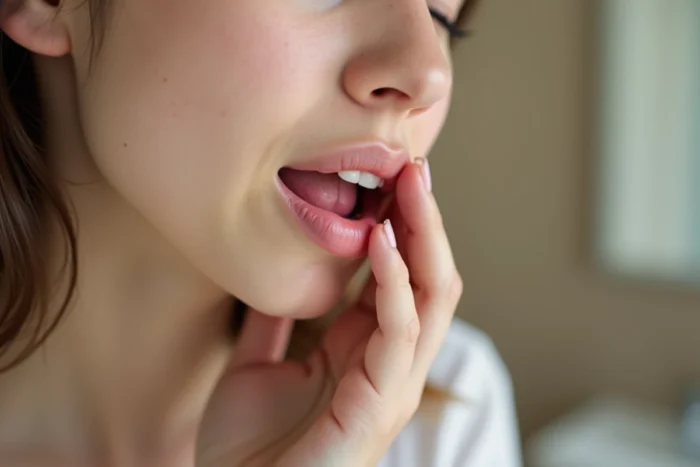
In practice, a patient presenting with giant aphthae or a resistant herpetiform form to topical corticosteroids requires specialized management. An aphthous ulcer that does not heal within three weeks necessitates a biopsy to rule out squamous cell carcinoma or pemphigus.
Failure of local treatments: which systemic molecules for refractory aphthae
When topical corticosteroids, chlorhexidine-based mouthwashes, and protective gels (hyaluronic acid) do not control outbreaks, the consideration of systemic treatment is discussed. This transition to systemic treatment is not trivial and falls under the specialist’s domain (dermatologist, internist, or stomatologist).
Colchicine often constitutes the first-line systemic treatment in refractory RAS. Oral corticosteroids in short courses may be proposed for severe outbreaks, but their prolonged use is not recommended due to cumulative side effects.
Thalidomide remains reserved for the most severe forms, particularly in the context of Behçet’s disease or debilitating giant aphthosis. Its use requires strict contraception and neurological monitoring due to the risk of peripheral neuropathy.
Alongside treatment, correcting documented micronutrient deficiencies (iron, folates, vitamin B12, zinc) helps reduce the frequency of outbreaks. These measurements are part of the basic assessment we recommend before any therapeutic escalation.
Underestimated triggering factors in recurrent aphthae
Beyond systemic causes, certain local factors deserve particular attention in adults failing treatment:
- Sodium lauryl sulfate (SLS) present in most commercial toothpastes irritates the oral mucosa. Switching to an SLS-free toothpaste reduces the frequency of outbreaks in a notable proportion of patients.
- Repeated mechanical trauma (ill-fitting prosthesis, sharp dental edge, chronic biting) maintains a cycle of ulceration that medication treatments cannot compensate for. A targeted dental examination identifies these causes in a matter of minutes.
- Certain foods (nuts, hard cheeses, citrus fruits, tomatoes) act as individual triggers. Keeping a food diary for four weeks allows for more reliably isolating problematic foods than a generic avoidance list.
The common mistake is to treat each outbreak without ever tracing back to the triggering factor. In adults, recurrence despite well-managed treatment almost always signals an uncorrected element in the oral environment, dietary habits, or ongoing medication. It is this methodical investigation, involving the primary care physician, dentist, and sometimes the internist, that ultimately breaks the cycle of recurrences.