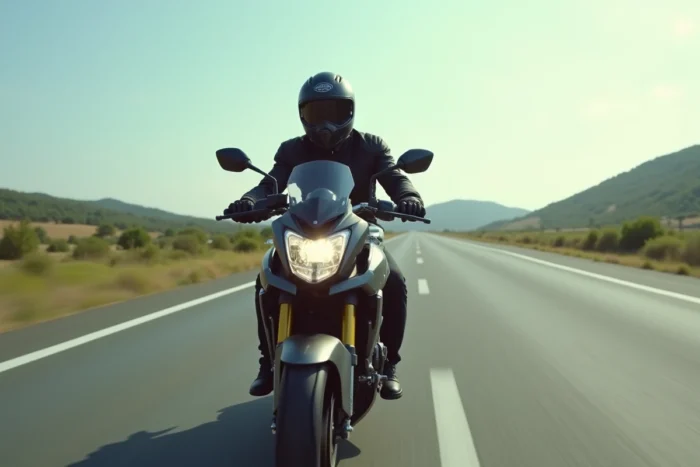
Riding a scooter on the highway is no longer an anecdote. With the evolution of maxi-scooters and the tightening of traffic conditions in urban areas, more and more riders are considering these two-wheelers for long, sometimes daily, trips.
The French regulatory framework allows access to fast lanes as long as the vehicle exceeds 50 cm³, but this legal authorization says nothing about comfort, safety, or the fatigue accumulated after two hours of maintaining a stabilized speed.
Actual displacement threshold for riding a scooter on the highway
The usual shortcut contrasts 125 cm³ scooters with maxi-scooters, as if the boundary between “suitable” and “unsuitable” lies exactly there. The mechanical reality is more nuanced.
A 125 cm³ typically reaches a top speed of around 100 km/h. On a national road at 80 km/h, that’s sufficient. On the highway at 130 km/h, the engine constantly runs close to its maximum RPM, with no power reserve for overtaking or reacting to an emergency situation.
Permisapoints explicitly recommends a displacement of at least 400 cm³ for regular highway use, citing models like the Piaggio MP3 500 or the Kymco CV3. This threshold allows maintaining 130 km/h in a comfortable torque zone, with enough margin to accelerate decisively when the situation demands. To know which scooter to choose for the highway, this technical data fundamentally changes the analysis compared to guides that stop at the 125 category.
Field feedback diverges on this point for intermediate displacements (250 to 350 cm³). Some light riders find them viable on the highway, while others report noticeable engine fatigue beyond an hour. The rider’s weight, crosswinds, and the elevation of the route play a role that technical sheets do not reflect.
Seat comfort and ergonomics on long scooter trips
The power of the engine is not everything. A scooter capable of maintaining 130 km/h but equipped with a flat seat and no backrest becomes an instrument of torture after 80 kilometers.
Three elements determine real comfort on a long trip:
- The shape and density of the seat: a wide seat with firm padding (not soft) distributes pressure better. Gel-type seats often lose their effectiveness after an hour.
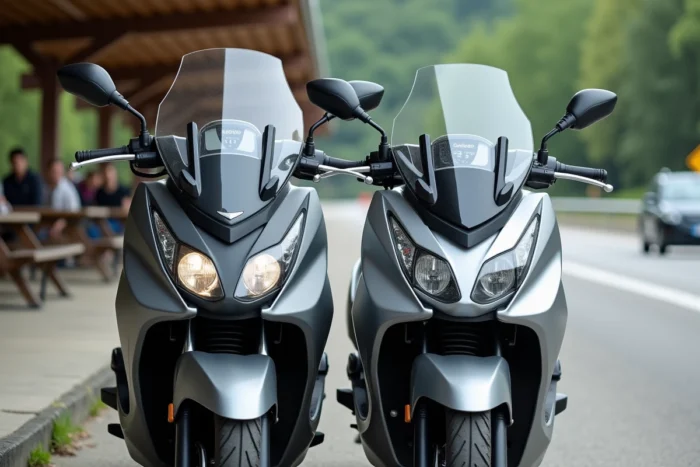
- Aerodynamic protection: a tall, wide windshield reduces neck fatigue caused by wind pressure. On the highway, this protection makes the difference between arriving relaxed and arriving exhausted.
- The position of the legs: a flat floor allows for changing posture. Fixed footrests in a rear position, typical of some sporty models, lock the body into a single position.
Aerodynamic protection takes precedence over raw power for perceived comfort. A well-faired 400 cm³ with an adjustable windshield will be more pleasant over 200 kilometers than a 500 cm³ with minimalist fairing.
Three-wheeled scooters on the highway: stability and constraints
Three-wheeled scooters (Piaggio MP3, Kymco CV3, Peugeot Metropolis) occupy a unique place in this debate. Their front end with two wheels offers significantly greater stability in crosswinds and on degraded road surfaces, two common situations on the highway.
Permisapoints highlights their advantages in terms of road holding and braking, particularly on wet surfaces. Braking on wet roads is the main advantage of three-wheelers compared to a conventional two-wheeler of equivalent displacement.
However, these models are heavier and wider. Filtering between lanes (interlining) becomes more delicate, and the extra weight is felt in low-speed maneuvers. On pure highway, this extra weight is not a problem. On a mixed city-highway route, it can weigh in the balance.
The question of the license also deserves to be raised. In France, some three-wheelers are accessible with a B license under certain conditions (7-hour training), which significantly broadens the potential audience compared to classic maxi-scooters requiring an A2 then A license.
Electric maxi-scooter and highway: where do we really stand
Competing content rarely addresses the electric option for long trips, and for good reason: the limitations remain tangible. Models like the Easy-Watts E-Cruiser display a motorization of 21,000 W (equivalent to 125 cm³) and a seat designed for suburban trips and fast lanes.
The manufacturer positions this type of vehicle for “suburban and fast lane” use, not for long-distance highway travel. The real autonomy, which drops significantly at constant high speed, remains the main drawback. Maintaining 110 or 130 km/h drains a battery much faster than an urban trip at 50 km/h with stop phases.
No electric scooter currently competes with a thermal maxi-scooter for a highway trip of more than a hundred kilometers without recharging. The available data does not allow for conclusions on a precise horizon of improvement, even though progress in battery density is regular.
For mixed use (city during the week, occasional highway on short distances), electric may be suitable. For regular long trips, thermal remains the only viable option at this stage.
Budget and real cost of a scooter designed for the highway
A maxi-scooter suitable for the highway costs significantly more than an urban 125 cm³. Beyond the purchase price, several factors increase the bill:
- Insurance: maxi-scooters are classified in higher risk categories, with premiums proportional to displacement and power.
- Maintenance: wider tires, more stressed brakes, more frequent oil changes on engines that work harder. Regular highway use accelerates the wear of consumables.
- Fuel consumption: a 400 to 500 cm³ consumes significantly more than a 125, especially at constant highway speeds.
The annual operating cost of a highway maxi-scooter is close to that of a small road motorcycle, which raises the question of the choice between the two. The scooter retains the advantage of seating comfort, under-seat storage, and automatic transmission, three points that matter in daily trips.
Choosing a scooter for the highway means accepting a higher investment than that of an urban two-wheeler, in exchange for versatility that few vehicles offer between city center and fast lane. The minimum truly comfortable displacement is well above what most guides suggest, and the electric option remains, for now, confined to short trips on fast lanes.