
The black ladybug is not a single insect. This name covers several species whose dark wing cases are the result of natural genetic variations, not some kind of cosmic message. To understand the meaning of the black ladybug, you first need to know which insect you are actually looking at.
Identifying a black ladybug: markings, species, and common mix-ups
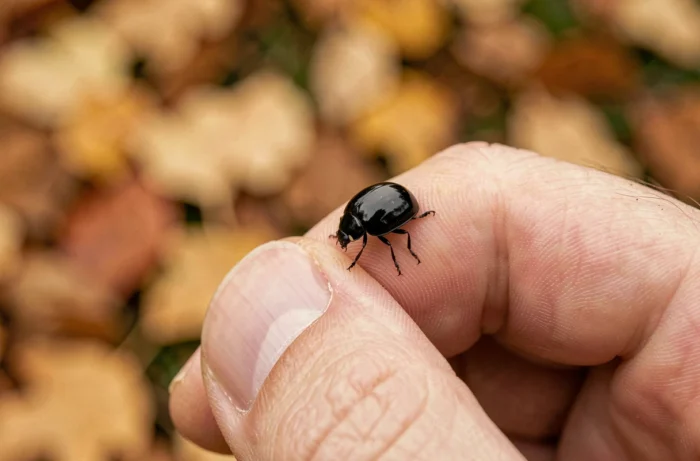
The term “black ladybug” refers to at least two common species in Europe. The two-spot ladybird (Adalia bipunctata) has a melanic form with black wing cases bearing red spots. The harlequin ladybird (Harmonia axyridis) can also have a very dark appearance, depending on the individual.
The most reliable way to identify a harlequin ladybird is by the M- or W-shaped marking visible behind the head, on the pronotum. This pattern remains visible regardless of the color of the wing cases. Color alone is not enough for a reliable identification. To learn more about the meaning of the black ladybug, you first need to understand these identification criteria.
- Melanic form of Adalia bipunctata: black wing cases with two to four red spots, black pronotum without an M-shaped marking
- Black form of Harmonia axyridis: black wing cases with varying red or orange spots, pale pronotum with a distinctive M- or W-shaped marking
- Other dark species: some fourteen-spot or checkerboard ladybirds have very dark coloring, but their size and number of spots are noticeably different
Checking the pronotum before looking for a spiritual symbol helps avoid attributing an omen to an insect that has been misidentified. Most black ladybugs found near homes in autumn are Harmonia axyridis, a species native to East Asia that has become widely established in Europe since the early 2000s.
Black ladybugs and the symbolism of good luck: what traditions say
The red ladybug with black spots is associated with good luck in most European cultures. Its popular French name, “God’s little beast,” roots this association in Christian folklore. Black specimens raise a different question.
Color reversal and popular interpretations
In French folk beliefs, a black ladybug with red spots is sometimes seen as a symbol that reverses the meaning of the classic ladybug. The reversed colors prompt uncertainty over whether it is a favorable omen or a warning. No established written tradition offers a definitive answer.
In East Asia, ladybugs of all kinds remain associated with protection and good fortune. The fact that Harmonia axyridis is native to this region may explain the absence of negative connotations in these cultures, even for dark-colored individuals.
Spirit animal and contemporary spiritual interpretations
Neo-shamanic movements and some personal development approaches portray the black ladybug as a messenger associated with inner transformation. In this interpretation, black represents introspection and the transition from one life cycle to another. This reading draws on modern symbolic associations, not an ancient body of mythology.
The black ladybug is neither a good-luck charm nor a bad omen in any documented tradition. These interpretations circulate mainly on digital platforms and vary from one author to another.
Why black ladybugs appear near homes
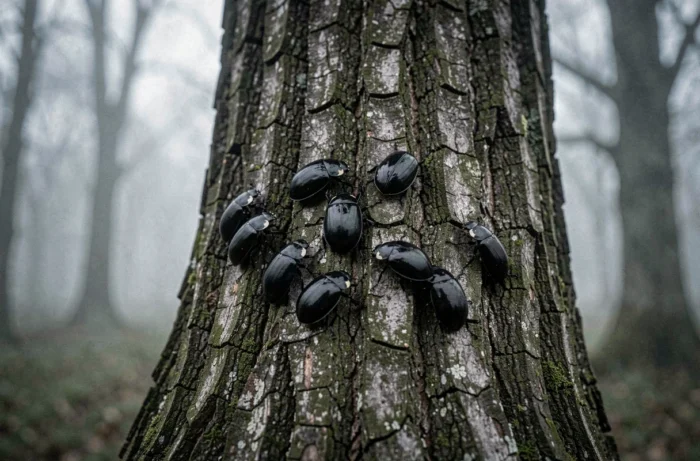
Before looking for a spiritual message, consider the ecological explanation. Harlequin ladybirds seek shelter to overwinter as soon as the first cold weather arrives. They gather on light-colored, south-facing walls, then make their way inside through windows and gaps.
Their presence in large numbers is nothing mysterious. It reflects the availability of aphids in nearby gardens during the warmer months, followed by well-documented gregarious overwintering behavior. Harlequin ladybirds were introduced as biological control agents against aphids, which explains why they are often found near cultivated areas.
This is a seasonal and predictable phenomenon. A surge of black ladybugs on a windowsill in October is a matter of entomology, not divination.
Black ladybugs: distinguishing personal beliefs from natural history
Assigning symbolic meaning to an animal is a personal choice. There is nothing wrong with seeing a visit from a black ladybug as an encouraging sign or a reminder to slow down. The problem arises when symbolic interpretation replaces observation.
We find that confusion between species fuels online stories in which an ordinary Harmonia axyridis becomes a “rare omen.” In reality, this ladybug is one of the most common in Europe. Its black coloring is the result of ordinary genetic polymorphism, found across all populations.
- A black Harmonia axyridis is no rarer than an orange individual of the same species
- The color of the wing cases is not correlated with any particular behavior or verifiable symbolic property
- Black ladybugs are no more likely to bite and do not carry different parasites from other color forms
The black ladybug remains a beetle whose biology is well understood. Its spiritual meaning, on the other hand, depends entirely on the person looking at it. Both interpretations can coexist without one having to erase the other, as long as symbolism is not confused with zoology.