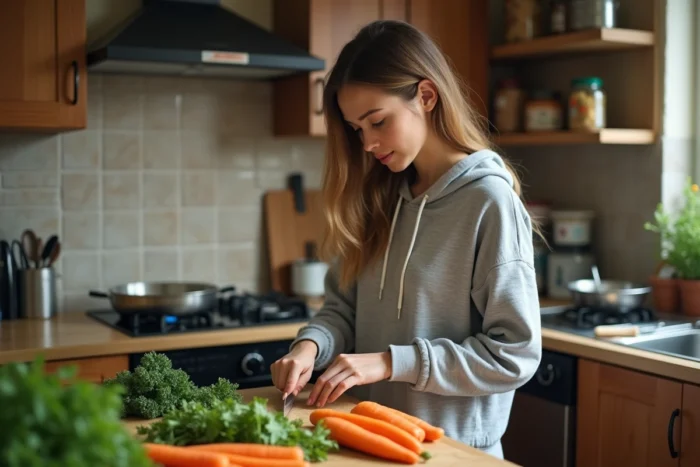
A student who cooks twice a week in batch covers most of their meals without resorting to industrial dishes. The technical foundation relies on three parameters: minimal equipment, ingredients with high nutritional density per euro spent, and cooking methods that do not exceed twenty minutes of active time. Smart and quick meals for busy students are based on this triad.
Student Batch Cooking: Yield per Minute and Euro
The profitability of a batch cooking session is measured in portions produced per unit of active time. Preparing a base of rice, a concentrated tomato sauce, and a batch of roasted vegetables in one session generates between four and six complete meals.
We recommend processing ingredients by cooking family rather than by recipe. While the rice cooks passively, the pan can be used to sauté eggs or toast spices. The oven, when available, can roast two trays of different vegetables simultaneously.
The real gain comes from passive time, not active time. Cooking rice absorbs twelve minutes without intervention. A vegetable gratin cooks alone for twenty minutes. During this time, you can prepare a salad or assemble wraps for the next day. It is by exploiting this logic of parallelization, detailed on my idea on TwimmCook, that student batch cooking makes perfect sense.
The weekly budget mechanically decreases when buying in bulk. One kilogram of red lentils costs a fraction of the price of four portions of prepared dishes and provides more plant-based protein.

Nutri-Score and Convenience Products: Read the Label in Thirty Seconds
Since 2023-2024, the strengthening of the Nutri-Score in European public health policies has pushed many brands of prepared meals, soups, and canned goods to reformulate their products. For a busy student, this concretely changes the “convenience” aisle of the supermarket.
A Nutri-Score A or B on a microwaveable dish was almost non-existent a few years ago. Today, several ranges of soups, canned legumes, and ravioli display these ratings. The reflex to acquire: compare the score, but also check the salt content, often the parameter that shifts a product from B to C.
Classic articles on student recipes ignore this evolution in the industrial offering. Having three or four reliable convenience references (a can of chickpeas, a vegetable soup, a microwaveable rice packet) ensures you never fall into the trap of repetitive triangle sandwiches.
Key Points to Remember in the Canned Goods Aisle
- Favor canned legumes (lentils, chickpeas, red beans) without added sauce: they serve as a protein base for a bowl, a salad, or an express dhal in the pan
- Check that the salt content remains below the perceptible threshold, a sign of a more recent formulation and often better-rated
- Canned fish (sardines, mackerel) provide fatty acids and can be eaten directly on bread with a squeeze of lemon, without any cooking
Meal Kits and Student Baskets: What a Turnkey Offer is Worth
Several meal kit providers have launched student-targeted offers since 2023: individual portions, recipes designed to take fifteen to twenty minutes, pre-measured ingredients. HelloFresh, among others, highlights quick and balanced “student” recipes, with the argument of lower cost compared to meal delivery.
The cost per portion of a kit remains higher than that of homemade batch cooking. The interest of the kit does not lie in raw savings but in reducing mental load: no shopping list, no unused leftovers, no waste.
For a student who has never cooked, the kit plays an educational role. After two or three weeks, most recipes become reproducible without the kit, using ingredients purchased in bulk at the supermarket. We observe that the real trap is the automatic subscription: without active cancellation, the monthly budget quickly rises beyond reasonable limits.
When the Kit is Justified, When it is No Longer Justified
The kit makes sense in the first weeks of food autonomy, or during exam periods when planning time drops to zero. Outside of these phases, buying five basic ingredients at the beginning of the week costs less and offers more flexibility.

Three Cooking Techniques to Master with One Pan
The pan is the only utensil present in all student kitchenettes. Three techniques are sufficient to cover nearly all quick meals.
Covered cooking on low heat transforms the pan into a mini-cocotte. Eggs, sliced vegetables, pre-cooked rice with a bit of water: the lid traps steam and reduces cooking time by about half. The result is more homogeneous than cooking over high heat without a lid.
Searing on high heat in a well-heated pan (without excessive fat) caramelizes vegetables and adds flavor without sauce. Zucchini, mushrooms, thinly sliced chorizo: two to three minutes per side is enough.
Cold mixing involves combining ingredients that do not require cooking in the still-warm pan (heat off): grated cheese, fresh herbs, a drizzle of olive oil. The residual heat melts the cheese and releases aromas without burning.
Quick Pan Combinations to Try
- Reheated rice, egg cracked directly on top, lid for two minutes, soy sauce: minimal fried rice
- Stale bread grilled dry in the pan, mashed avocado, poached egg on the side: complete toast without a toaster
- Drained canned lentils, sautéed chopped onion, cumin, lemon juice: express dhal in under ten minutes
- Tortilla filled with cheese, folded in half and pressed in the pan: crispy quesadilla without an oven
The difference between a bland meal and a tasty meal rarely lies in the recipe. It lies in mastering the heat source, choosing one or two distinctive condiments (lemon, soy sauce, mustard), and the freshness of a single raw ingredient added at the last moment. A successful student meal requires no more than five ingredients, provided each plays a specific role on the plate.