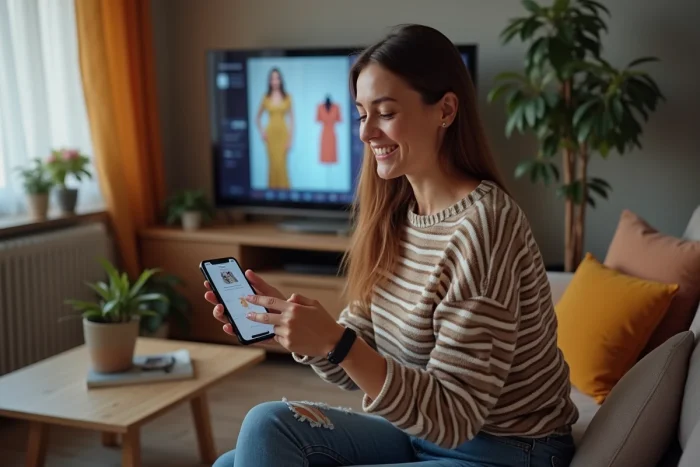
For millions of visually impaired people, accessing fashion trends broadcast on television remains an obstacle-laden journey, far from the immediacy promised by the digital age. Traditional search engines and e-commerce platforms struggle to fill this gap, often unable to link a fleeting image to a specific reference.
Technological tools based on artificial intelligence are now shaking up this status quo. Now, the dress glimpsed fleetingly in a news broadcast or the star jacket from a series no longer disappears as soon as the screen is turned off. A candid photo, a few keywords, and the engine reveals the exact reference or credible alternatives, designed for all profiles, regardless of visual acuity. What was once only a dream is taking shape, accessible in no time.
When technology reshuffles the cards of fashion on television
In Évreux, Julien Capra, Rémy Villecroze, and Marc Decombas have shaken things up with their app Watiz. Their project does not just aim to identify a garment seen on television: it does so quickly, directly, relying on powerful image recognition algorithms. Even imperfect screenshots resonate within a vast database, boasting a million references and 3,000 brands, both major and niche. Access is open to all desires, from ultra-trendy wardrobes to unique pieces.
Some tools prefer simplicity over an overload of functions. For example, the Fashion Marker app to spot a garment seen on TV focuses entirely on speed: one photo sent, one direct response. With Watiz, video recognition and drive-to-store further expand the realm of possibilities. One can locate a model in-store or receive real-time recommendations that follow the thread of each image. The gap between what is seen on screen and what enters one’s wardrobe continues to close.
Find the outfit spotted on television in seconds
The image recognition makes the search for the desired piece almost trivial. No longer is it necessary to endlessly scour the web, juggle between sites, or zoom in on screenshots. Today, photographing the right garment, opening the app, and receiving a complete list of suggestions can be done in just a few minutes. Downloading via App Store or Google Play poses no obstacle, and the user journey, designed for everyone, reassures those who consider themselves less tech-savvy.
To visualize this new reflex, here’s how the search unfolds, step by step:
- Take or import the photo of the garment seen on television directly from the smartphone
- The app scans the image and locates the model that is closest
- Discover a selection of nearly identical items, in new or second-hand versions
- Choose the right item and finalize the purchase through partner sites
Every user can follow this simple path to identify the hoped-for piece:
Clothing recognition is no longer limited to just garments: shoes, bags, jewelry, accessories—nothing escapes this constantly enriched engine. The platform also includes a wall of inspirations: anyone, whether a user or influencer, can share their finds. Inspiration flows, trends are built together, and for the most demanding, real-time recognition via video or in partner stores offers even more responsiveness. The online and in-store experience intertwine seamlessly.
Sort and shop more consciously
By opting for an intelligent clothing search, one never settles for just a name. One puts into perspective desires, manufacturing, and the product’s story. Stylist Lucas confirms this in his daily life: “More and more clients arrive with a photo captured on a TV set. Today, discussing the origin, the making, or the approach of brands has become as crucial as the look itself.”
Before confirming their cart, certain markers help clarify choices and shop without second thoughts:
- The SloWeAre label, which invites one to look at the behind-the-scenes: social impact, ethical approach, and environmental concern.
- Clear Fashion, the app that makes labels speak, decoding the entire journey and reliability of garments. With each scan, transparency gains ground.
There are several options for adopting a more responsible fashion approach:
Fashion is reinventing itself, driven by the need for coherence as well as the desire for bold novelty. Digital tools are here, waiting to be seized to reshape one’s habits and clothing choices.
Between instant access to the spotted piece and heightened awareness of each garment’s journey, television ceases to be an inaccessible showcase. It becomes the spark of a renewed style: one spots, identifies, chooses, and fashion finally takes the time for accuracy, without sacrificing spontaneity.